Lean Data Lead Distribution
At Google, I managed the account based marketing program for Google Cloud's top 5% of enterprise accounts in healthcare, tech and media.
I ran the build around a simple rule: only ask prospects for data that directly changes a routing or scoring decision, enrich the rest behind the scenes, and route every contact at the account level rather than treating them as isolated leads.
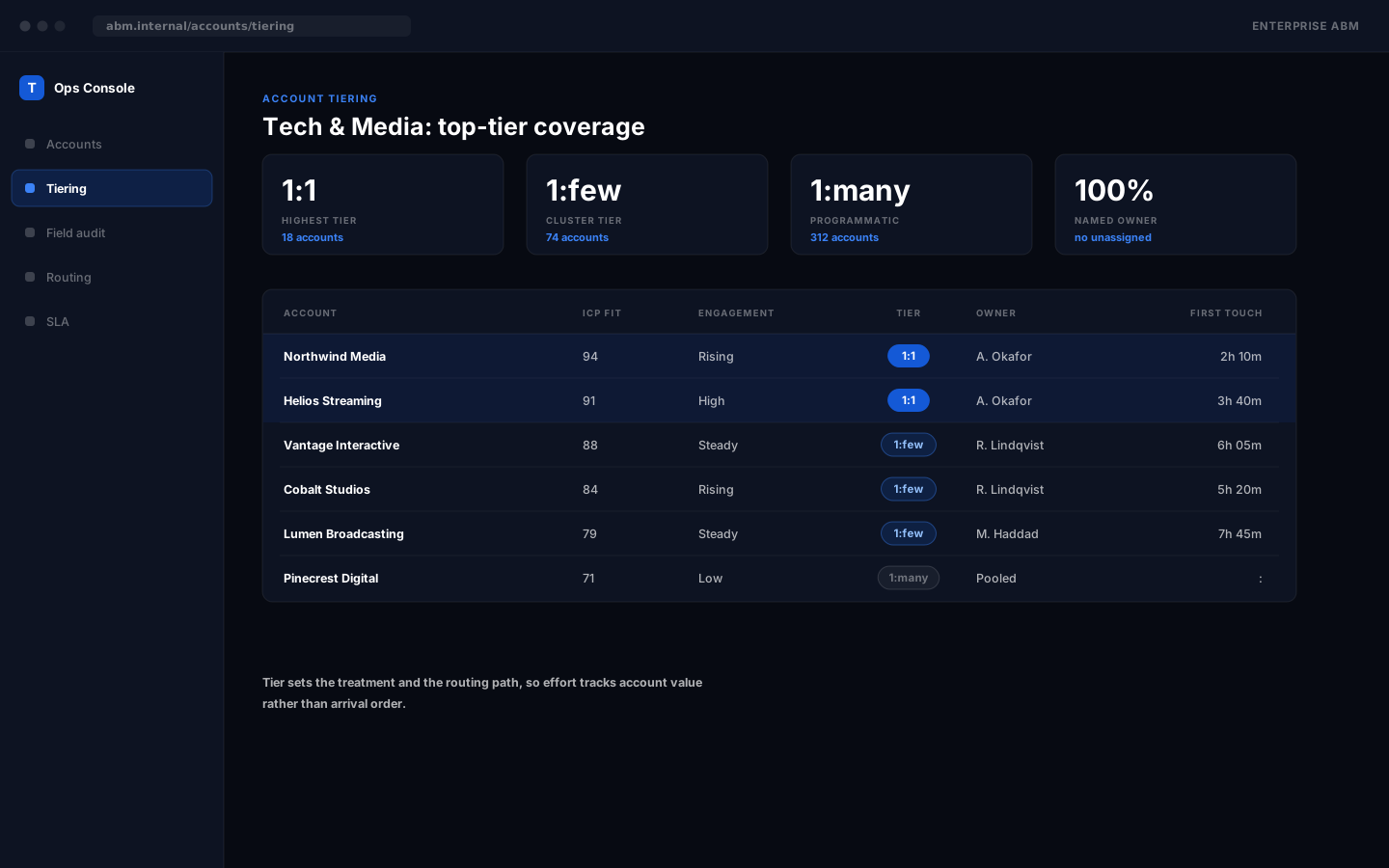
A note on these screens. They are a drafted simulation of the campaign operations work I managed, rebuilt from scratch so I can show how the system actually worked without putting any internal company data on a public site.
The problem
This enterprise segment existed on paper, but there was no actual operational framework behind it. Without a tiering model to prioritize accounts, sales and marketing gave the exact same level of effort to every company, regardless of its actual revenue potential.
Our lead capture forms were also getting in the way. Over the years, various teams had tacked on custom fields for their own reporting. We ended up with bloated forms that hurt conversion rates, even though most of the data we collected wasn't connected to a single scoring, routing, or segmentation rule.
What I built
- An Account Tiering ModelI designed a scoring model that graded accounts on ideal customer profile fit and active intent signals. That score determined whether an account landed in a one to one, one to few, or one to many motion, which dictated both our marketing budget and how sales handled the outreach.
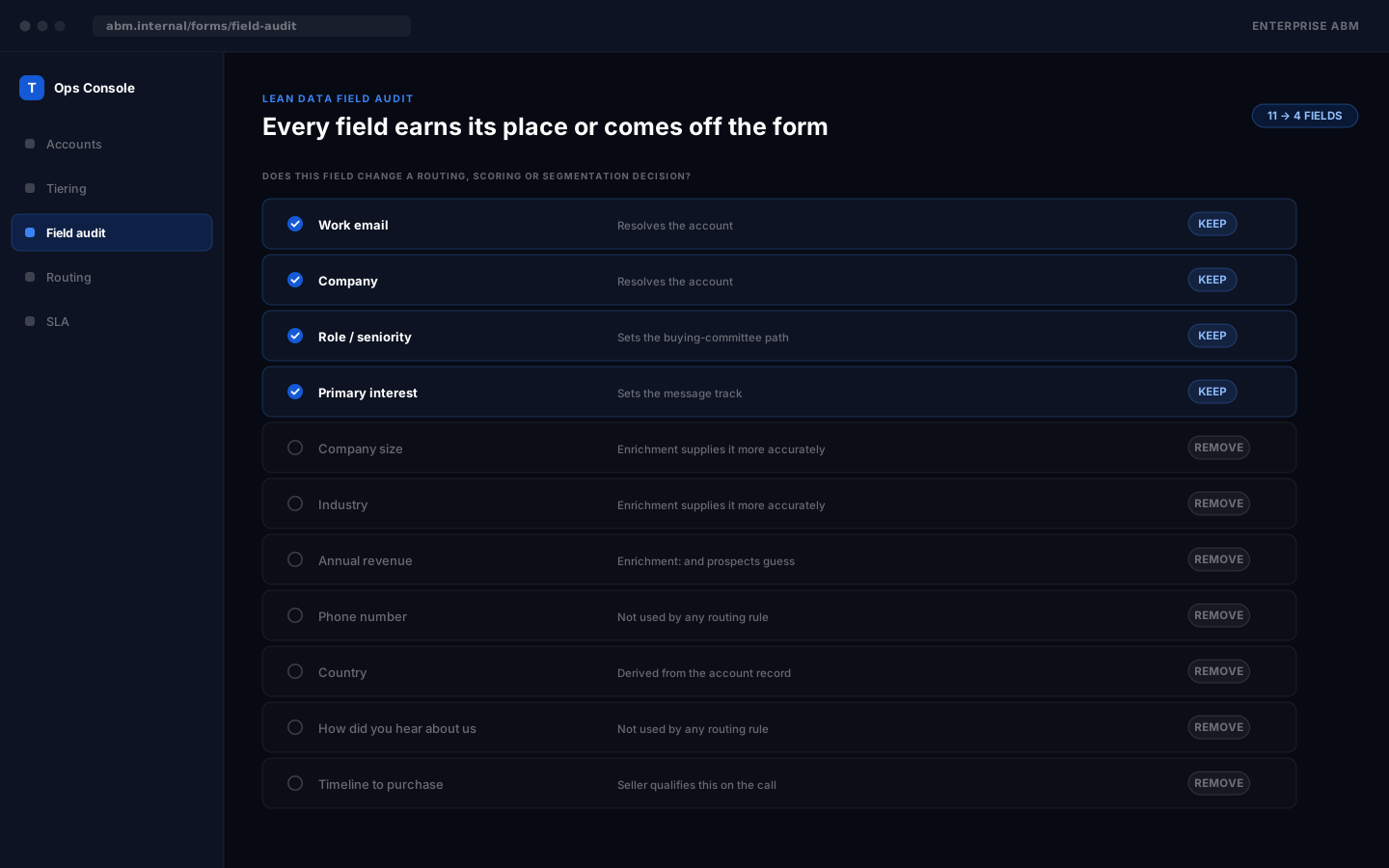
- A Lean Data ModelI audited every form field across our pages and trimmed our standard lead form down from eleven fields to four. If an input didn't immediately change how we scored, segmented, or routed the prospect, I took it off the form and used backend enrichment to capture the data instead.
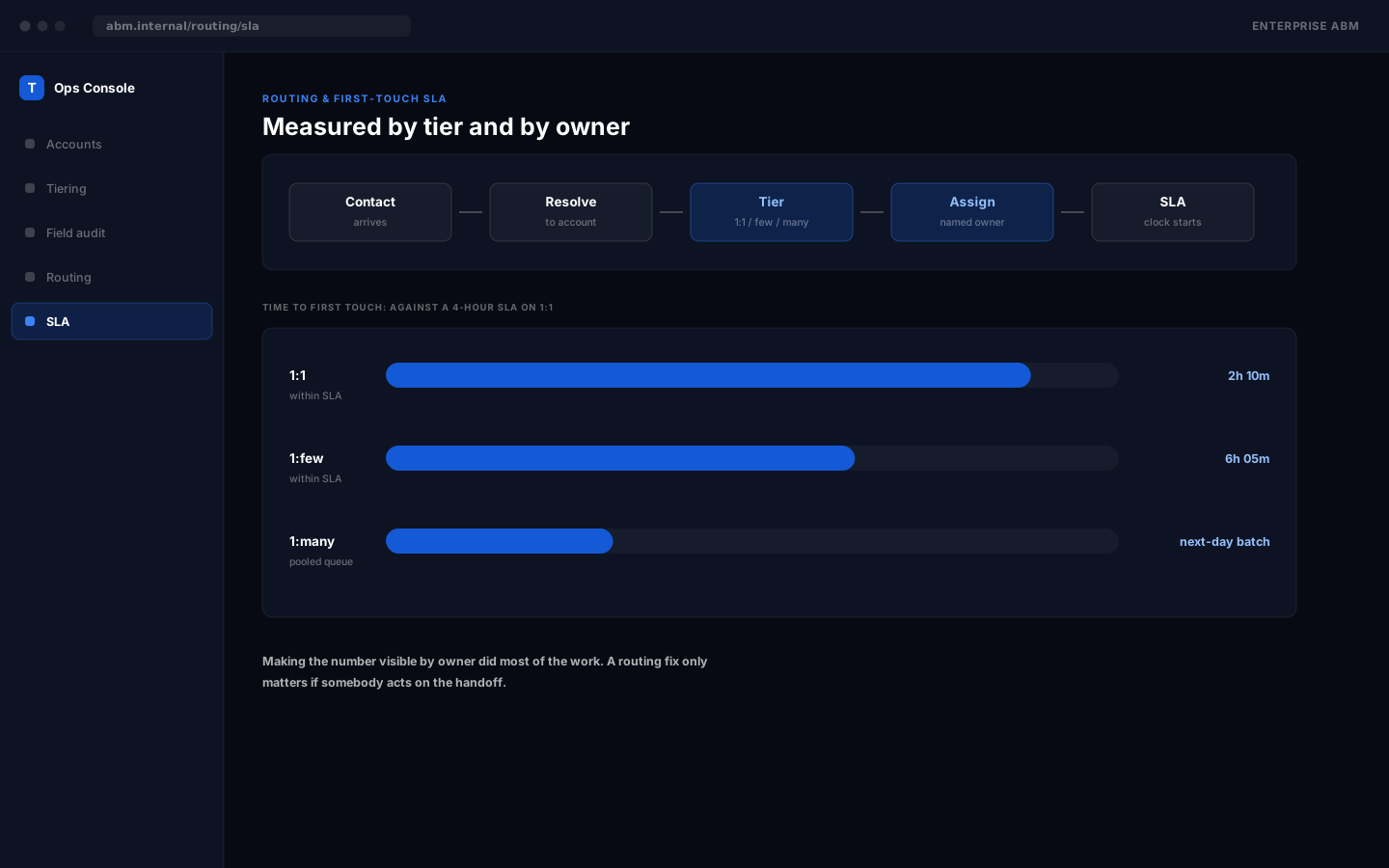
- Account Level RoutingInstead of routing form submissions as standalone leads, I rebuilt the logic to match contacts to their parent account first and send them straight to the dedicated account owner. That way, when multiple people from the same buying committee reached out, they all landed with the same rep alongside the account's full engagement history.
- A Tracked First Touch SLAI set up system timestamps and BI dashboards to track time to first touch across every tier and sales rep, giving leadership clear visibility into follow up speed.
- A Closed Loop Feedback SystemI connected sales disposition data back into our scoring model. By tracking which accounts actually progressed and closed, we continuously adjusted our scoring weights based on real pipeline outcomes rather than relying on our initial assumptions.
- Handoffs Built with Sales ContextGetting a lead to a rep quickly doesn't help much if they don't know how to start the conversation. I attached enterprise case studies and vertical specific proof points directly to the routed alert so sellers had relevant talking points ready to go on day one.
The Form Field Audit
To keep conversion rates high, every field on our forms had to survive a strict review. Most of them got cut. I ran every requested field through five questions:
- Does this field change which tier the account lands in?
- Does it change which sales rep gets the contact?
- Does it change the lead or account score?
- Does it change the audience segment or the messaging they receive?
- Can our enrichment tools pull this data more accurately than the user typing it in?
- If the answer to the first four questions was no, or if enrichment could fill the gap automatically, the field was removed.
What made it hard
Because I was building this architecture for a brand new segment, there was no historical baseline to point to. I had to define what a good outcome looked like and get sales leadership to commit to new routing rules and SLAs before I had internal data to prove the model worked. Winning that buy in was much more of a trust and alignment challenge than a technical one.
Need one of these built?
I build the layer underneath campaigns, and the reporting that shows whether it worked.